Coaching young athletes fell on my lap by accident over 15 years ago. I saw the opportunity as a calling.
I have coached competitive Olympic weightlifters to national level. I have coached competitive powerlifters who have set state and national records. I have strength trained many young lifters from different sports who have become Collegiate Division 1 athletes.
Strength training is the foundation often neglected. All else being equal, the stronger and more explosive athlete will always beat the weaker one.
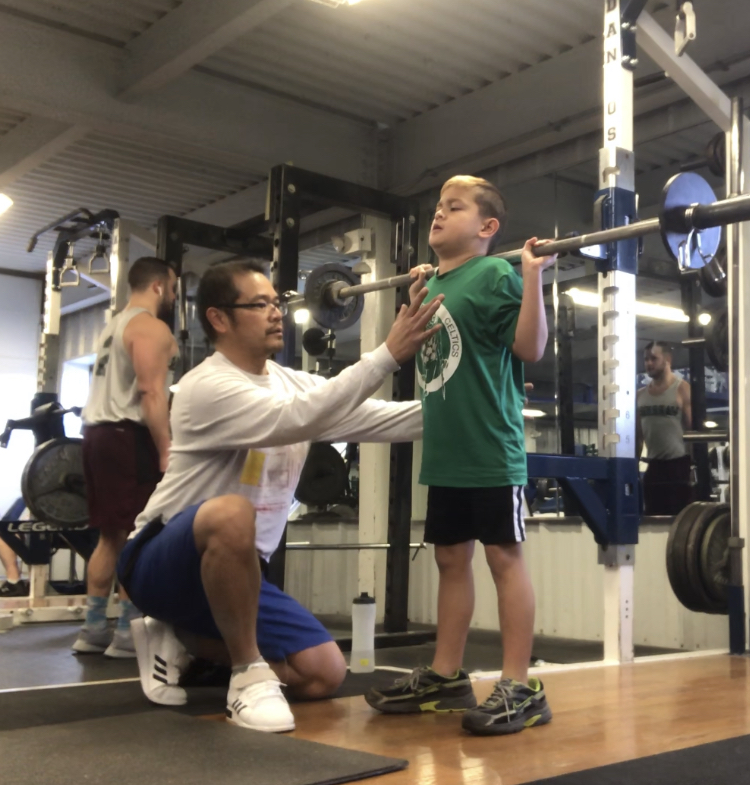
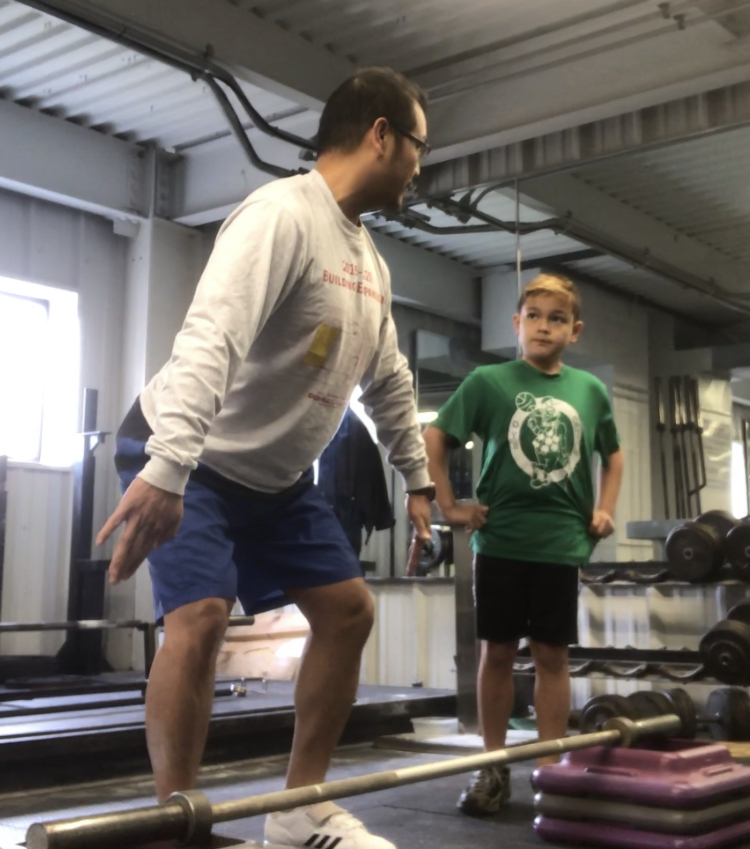
Aaron has been training for a few months. His parents came to me to help him with strength and explosive power.
He plays multiple sports to include baseball and soccer.
His typical training consists of either back or front squats, explosive lifts (Olympic lifts), some type of upper body strength, and once in a while we do ladder drill.
In this particular session, I wanted to make it fun for him so he did some kind of conditioning to include rope climb followed by pushups and “icky shuffle” on the ladder.
There is a clear relationship between rate of force development (RFD) and multiple components of physical performance like jumping, sprinting, throwing, and quick changes of direction.
Not only is RFD an integral component in anaerobic and aerobic performance, it can also be used to differentiate athletic performance. Some tests, such as the broad jump, may be used as a reliable way to assess general fitness.
The primary purpose of the broad jump is to measure lower body explosive power and horizontal force production.
Broad jumps can also be included in training. I personally only use it to gauge progress and performance.
Andrew does not normally perform box jumps or broad jumps. In fact, after years of training, this was the first time I tested his broad jump.
He jumped at 97-inches (247 cm). And according to the table below, his performance places him well over 95th percentile.
This is the result of years of Olympic weightlifting.
One thing I will always appreciate about having been a penniless immigrant in America who had to learn English and assimilate into the culture was that I experienced firsthand what it’s like to be an underdog.
I love underdogs. Americans love underdogs.
Andrew entered his third Weightlifting Nationals. He competed in the 14-15 year-old, 67-kilo class. He was one of the youngest and the lightest. At a bodyweight of 138-lbs, he was closer to 61-kilo (the next class down), than he was at 67-kilo.
The big dogs he competed against came from well-established weightlifting facilities from all over the Nation that have produced countless national, worlds, and Olympic caliber weightlifters. Further, the 15-year-olds he competed against have already gone through puberty. Big, bad, hairy testosterone is on their side.
Then there’s Andrew who humbly trains in the corner of the basketball courts at the gym (and sometimes in the basement garage at home) and his goat-farming coach / dad. We were clearly the underdogs. We were the Davids in an arena full of Goliaths. But we feared NOBODY. Because underdogs built America. Underdogs are the ones whose stories are often remembered. Underdogs are the ones who remain hungry and become the next top dogs.
Andrew’s mentality was fierce. My general advice of “it’s you versus you” does not apply to him. He didn’t just want to compete against himself. He wanted to compete against the top dogs, despite being realistic that he will not place this year.
His snatch opener was 53-kg (117-lbs). His second attempt was 57-kg (125-lbs). It was his all-time PR. Third attempt was 60-kg, approaching his bodyweight. He missed his last attempt, but we were happy with the decision to go all-out.
His clean and jerk opener was 67-kg (147-lbs). RPE of less than 5. Second attempt was 72-kg (158-lbs). He got 2 red lights as a result of soft pressout in his left arm. No biggie. I asked him if he wanted to try again on his third attempt.
He said, “No, dad. I want to increase to 75-kilos (165-lbs).” Increasing the weight after a missed lift is something you only see at the Olympics. It takes a lot of mental tenacity to have this mindset.
I said, “Okay bud. I will not tell you what to do. Because you know what you have to do.” (Sometimes over-coaching is worse than under-coaching.).
He took the almost the entire one minute on the platform to mentally prepare.
In the background I simply reminded him to “close, fast, low, lots of violence.”
He focused on the clean first. He hit it no problem. He then took a few seconds to tighten his position on the jerk. Then he attacked with all ferocity and received all white lights. 75-kilo (165-lbs) almost 30-lbs over his bodyweight, was his new all-time PR.
He may not have medaled this time around, but he beat his old self from the last qualifications meet just several weeks ago by 25-lbs. He set 2 new PRs. His total last meet was 121-kilo; today he hit 132-kilo.
Knowing him, he will keep that burning desire in his heart hotter than Kung Pao chicken on steaming white rice. Because our next big goal is to medal next year. Next year, he will be the top dog.
#HoofGripWeightlifting We train BAAADAAASS athletes.
Back in late August 2022, Andrew hurt his knee when he landed on a trampoline in an unsafe manner. He did not do any weightlifting-type moves for at least 6 weeks until we got clearance from the doctor. A few weeks ago, the MRI thankfully confirmed that his knee was fine and the doctor gave him the green light to resume training.
During the healing period, I had him do nothing but upper body push-pull, high rep, type bodybuilding training. He also did lots of core.
Bodybuilding will make you stronger, but that is not the primary goal of bodybuilding. Bodybuilding’s primary goal – through volume – is muscle hypertrophy. Although strength and power are a function of the Central Nervous System (CNS), bigger muscles will generally also make you stronger. Bodybuilding is about appearance, strength training is about performance. But each can benefit from the other.
When Andrew resumed training, we started with the power versions of the competition lifts (catching the bar high), with the intent of slowly getting him back into the full positions.
I tested his power clean and jerk, and to both of our surprise, he set a 100-lb PR with an RPE of 5. Only one explanation: Those upper body push-pull and core training made him stronger.
Andrew has been training since he was 9. I signed him up to enter his first meet in 2020, but the plan was cancelled due to Covid. He continued to train throughout 2021.
January 2022, he entered his first meet. His total lift at that local meet qualified him for Youth Nationals in June 2022, at the age of 12.
Hard to believe Andrew has been weightlifting for 2 years. He started in November of 2019. He was barely 75-lbs. Just the other day we reviewed some of his lifts when he first started. We both laughed at how “cringey” he moved.
But I knew he would do well in the sport. He was only 9 at the time. But he already had the mental maturity and tenacity, and right level of focus required for the sport.
We set a goal: BODYWEIGHT CLEAN AND JERK.
As his skill set improved, as he got stronger, he also gained mass and naturally got heavier. As we came close to our ultimate goal of bodyweight clean and jerk, his weight went up, and we kept moving the goal post.
I did not rush the process. His safety came first and foremost. And I made sure I did not push him too hard as it would only serve to discourage him. I wanted him to have fun in this journey. He’s a kid. Kids are supposed to have fun.
Good things happen when least expected. He had a growth spurt and his back and front squat strengths skyrocketed. Further, his hands were able to “hook grip” the bar more comfortably. So we decided to take advantage.
He maxed out on the cleans only. He was able to clean his bodyweight with no problem. The RPE (rate of perceived exertion) was only 5 out of 10. (At his stage, I rarely go above RPE of 7.)
The following week, HE SEIZED THE MOMENT and finally lifted his bodyweight overhead.
A parent who is taking the role of a coach to teach a child who is taking the role of an athlete is oftentimes difficult.
Why? Because….
“Familiarity breeds contempt” -Proverb
The more acquainted one becomes with a person, the more one knows about his or her shortcomings and, hence, the more difficult it is to see the father as a coach, or the child as an athlete.
But if the roles in the proper environment are respected and understood by both, the relationship can easily become the rule rather than the exception.
If the father is treated the way any other coach is treated, and if the child is treated the way any other athlete is treated, the overall relationship will develop into something special no other coach-athlete / father-son will experience.
There is no such thing as “too old” or “too young.”
Age is just a number.
For younger lifters, the most important consideration is the youth’s level of maturity. Weightlifting is a great sport. It’s a fun sport. But it also requires a high level of focus. Children are supposed to be just that – children. They’re supposed to have fun. Parents should expect their kids to be curious and expect them to explore. Children should never be forced to participate in anything against their will. Introduce different activities to them, but leave it to them to decide for themselves.
If a kid cannot focus on weightlifting because the gym has many machines and they’re distracted, it’s okay. Let them have fun by doing other things. Get creative. Make fitness fun.
But if a child is mentally ready to lift weights overhead, regardless of age, they’re ready to be

 HoofGripWL