I don’t watch football. But the other day my father-in-law happened to be watching college football on ESPN and the Gators were playing. I used to coach a Gators player.
Chris, #67, currently plays as Offensive Guard. While he was still a junior in high school he had already received at least ten Division 1 football scholarship offers. He chose to attend the University of Florida. At the age of 17, he could have easily qualified for the Youth Nationals had he entered a weightlifting meet.
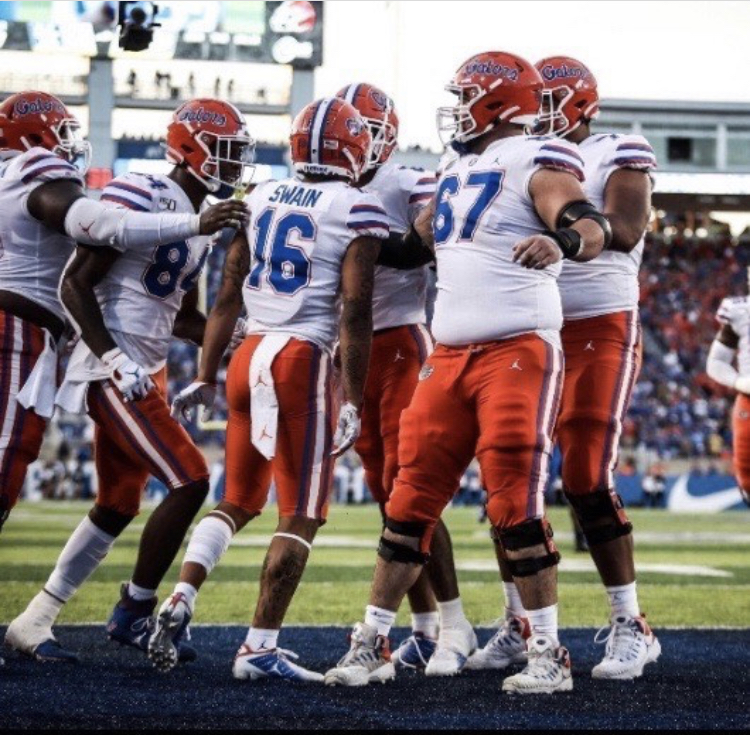
At any rate, I was inspired to write this entry when I saw him on TV.
If you ask 10 different coaches, you will get 10 different answers. That’s just how it is.
I keep things simple:
a) If an athlete has the flexibility, I teach the ‘squat snatch’ and ‘squat clean’ versions (CrossFit terms), or simply snatch and clean (Weightlifting terms).
b) If an athlete lacks flexibility, no problem. Power cleans and power snatches to the rescue, where the lifter receives the bar with legs above parallel. However, I would also work with the athlete to improve his or her mobility.
It’s common for many strength and conditioning (S&C) coaches to focus only on the power versions. Common misconceptions include:
a) The power versions will teach the explosive ‘triple extension’ better.
b) The squat versions are only for competitive weightlifters.
c) His frame is too large to get into the bottom position, so we will stick with power.
These ^^ are NONSENSE.
Both power and squat versions teach the athlete how to generate explosive power.But the squat version will allow the athlete to lift heavier weights as the bar does not need to accelerate as high as the power version. The squat versions will also readily expose lack of flexibility.
The most overlooked aspect of general athleticism is flexibility, or lack thereof. If the athlete can only perform the power version due to lack of flexibility and mobility, the coach must treat as a weakness. If an athlete cannot get into the ATG position, this should be viewed as an opportunity for improvement.
Flexibility is an important component of fitness for both the general public and athletes. It improves blood flow and circulation. More importantly, flexibility can prevent injuries because it will allow the athlete better range of motion. Think about it. Most sports involve movements that are UNPREDICTABLE. If an athlete moves in a way that exceeds his or her limited range of motion, injury will occur.
Olympic weightlifters are some of the most flexible athletes in the world, only next to gymnasts. The classic lifts will help athletes become stronger and more explosive, but they will also expose positional weaknesses resulting from lack of flexibility that sports performance coaches must seriously take into consideration.
 HoofGripWL